
A talk given at St Giles on Sunday 12th March
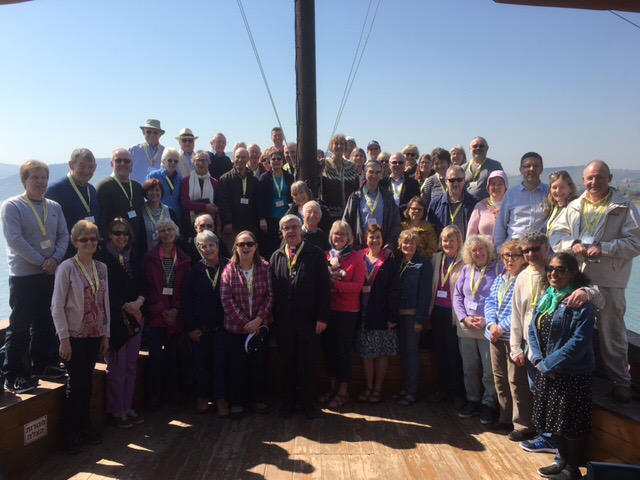
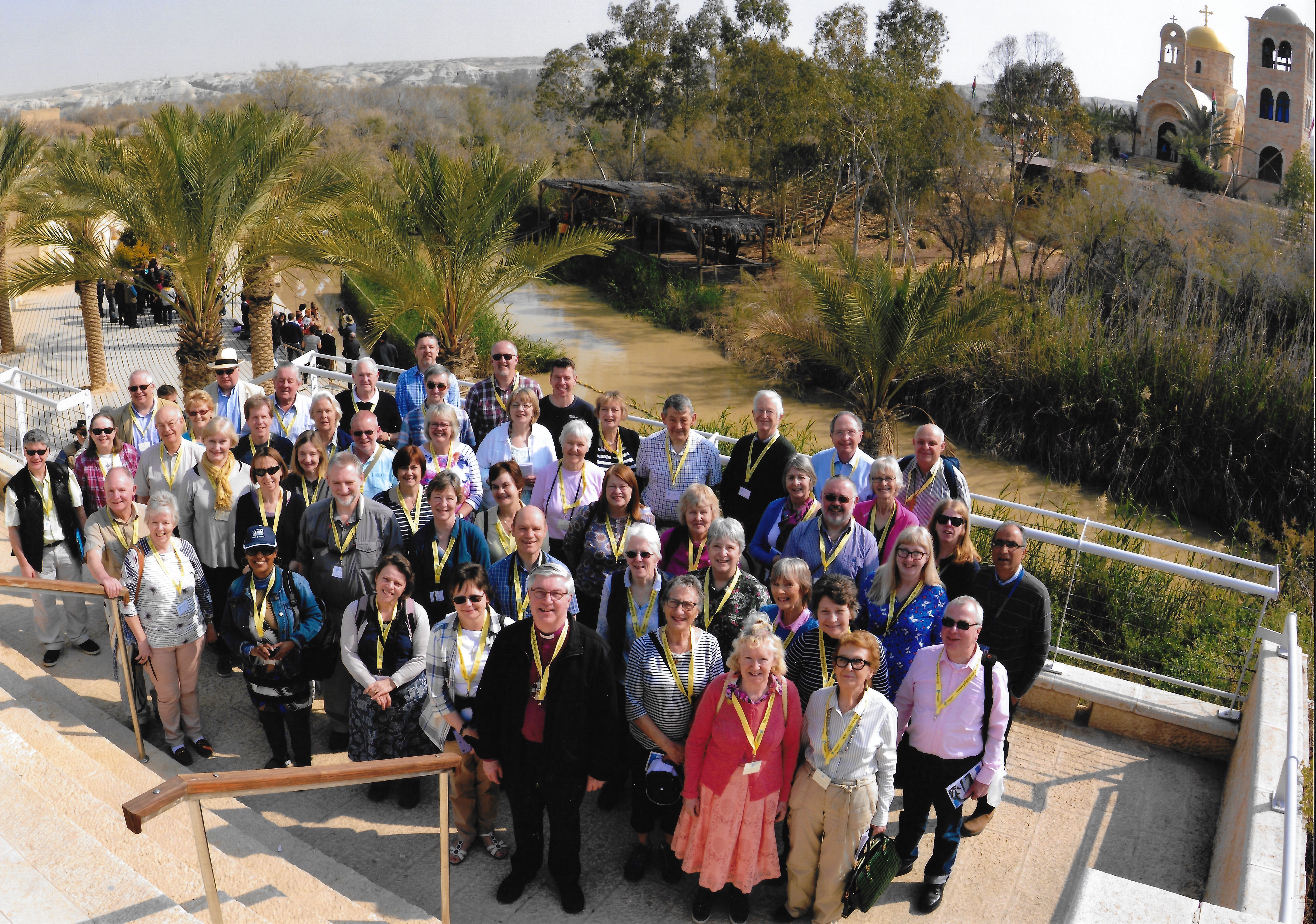
Pearl, Fr Darren and I were all fortunate to have been picked in a draw to go on Bishop Graham’s pilgrimage to the Holy Land this year. Just over 50 of us from around the Diocese had been chosen at random as the pilgrimage was over-subscribed. It was a wonderful opportunity to meet clergy and parishioners from around the Diocese whilst visiting the most holy places in the world.
We walked in Jesus’ footsteps through the Holy Land. We saw the remains of the house of Mary in Nazareth where she was told by the angel Gabriel that she would give birth to the Son of God; we knelt at the very place where Jesus was born in Bethlehem; we saw Joseph’s workshop in Nazareth; we renewed our Baptismal vows at the very spot that Jesus was baptised by John; we visited Cana in Galilee, where Jesus performed his first miracle; we travelled around and on the Sea of Galilee where so many of the defining parts of Jesus’ ministry took place, walking on the same floor as he would have done when he taught in the Synagogue next to Peter’s house in Capernaum; we went to the place where the Sermon on the Mount was preached, as well as where he fed the five thousand from five loaves and two fish and we sailed out onto the Sea of Galilee as the fishermen in the gospels did. We went in minibuses up the steep and winding road to the top of Mount Tabor where the Transfiguration took place; we followed the path of Jesus through Jerusalem down the Mount of Olives, suffering in the Garden of Gethsemane, visited the place where Peter denied Jesus three times before the cock crowed twice. We walked the route that he was forced to carry his cross and stood at the places at which he was crucified and buried. We also walked where the risen Christ cooked fish for the disciples on the shore of the Sea of Galilee.
We also learned from a speaker from the Holy Land Trust, students at Bethlehem University and residents of the Dheisheh refugee camp what life is really like in modern Israel and Palestine; Palestinians are unable to stay in their own properties when the Israeli’s move in, destroying and occupying whole towns. Palestinians live in an occupied territory, having to comply with the Israeli Army presence. The injustice is not about religion, especially in Palestine where Muslims and Christians live happily side by side and the students in particular did not know which of their friends were Christian and which were Muslim. Jews are not allowed to cross the Israeli-guarded border into Palestine a restriction imposed by the Israeli’s. Israel is a mixture of Christians, Jews and Muslims, but with Christians forming only just over 1% of the population; even here, religion is not a barrier between people. The Palestinians want justice rather than simply peace, something that they cannot see happening in the near future.
But, of course, these two descriptions are of the same places. Reflecting on it, there is probably a good reason why this tension does not destroy the visit to the sites where Jesus lived, worked and died. After Jesus’ birth the holy family became refugees in Egypt to avoid the slaughter of children under two years old and stayed away until it was clear that Herod’s son did not continue the same vendetta. The land that Jesus grew up in was occupied by the Romans, so he also would have had to obey soldiers from another country as he went about his daily life; this becomes very clear in the descriptions of his accusation and crucifixion, when he was crucified by that same occupying force. Seeing the places from the bible with similar tensions adds to, rather than takes away from the experience. It makes it real; it makes it understandable; it makes it relevant.
So what did I learn? Overall, it’s not a pretty place. If you want old beautiful churches full of religious art, go to Rome. There were some wonderful churches and locations (my favourites being the Garden of Gethsemane and the Garden Tomb), but most of the sites in the Holy Land are either quite recent, or are renovations of the 12th century buildings erected by the Crusaders. If you want to experience the places that Jesus visited, you must go to the Holy Land. The fact that some of the locations are, well, “probably” accurate and the fact that we saw two places that we are told was where the annunciation took place, two sites of the crucifixion and two tombs doesn’t really matter, as you will have been close enough to somewhere that Jesus had lived and walked. You also need to ignore some of the more touristy sides to the locations, such as Temptation Gallery in Jericho, at the foot of the mountain where Jesus spent forty days and nights and was tempted by the devil. I learn’t more about the tension between Palestine and Israel than I would have done without visiting and talking to the people there. Finally, I discovered much more about where events in Jesus’ life happened; for example, in the bible and hymns you will hear about Jesus on the Sea of Galilee, the Sea of Tiberias, the Syrian Sea and Lake Gennesaret. Now I know that these are all the same place! So when I read the bible from now on, I don’t just want to know what happened, but where it happened – I will always read with a map handy. Jesus behaved differently in different locations. For example, on the Nazareth side the people he healed were told to tell no one; on the Syrian side they were told to go and give thanks publicly. I can tell you where the events in today’s* Gospel took place: Jerusalem. I can also tell you that Nicodemus, whom Jesus meets for the first time as a Pharisee in this gospel, together with Joseph of Arimathaea, prepared the body of Jesus for burial, a task that was usually women’s work. What a journey Nicodemus went on between the two events!
We couldn’t have visited so many sites and learnt so much without a wonderful, knowledgeable and entertaining guide together with a fantastic driver; I’ll leave you with one of our guide’s jokes. A priest and a coach driver die and arrive at the gates of heaven together. St Peter asks them both to wait whilst some checks and balances are being taken. The priest then notices a red carpet being laid out for the driver and questions Peter why he is being given entry to heaven first and receives the following explanation: “When you preached your sermons, your congregation slept; when this man drove his coach, his passengers prayed!”
* Second Sunday of Lent, Year A: John 3: 1-17

 iangraydon